What Can a Firm With Market Power Do
Learning Objectives
- Explain how wages and employment are determined in labor markets where employers have market place power (monopsonies)
In the modules on market place construction (i.e. perfectly competition, monopoly, oligopoly, and monopolistic competition), we observed that while economists utilize the theory of perfect competition as an ideal example of market place structure, in that location are very few examples of perfectly competitive output markets in the real world. What about labor markets? How many labor markets are perfectly competitive? There are probably more examples of perfectly competitive labor markets than perfectly competitive product markets, just that doesn't hateful that all labor markets are competitive.
When a job applicant is bargaining with an employer for a position, the applicant is often at a disadvantage—needing the job more than than the employer needs that item applicant. John Bates Clark (1847–1938), oftentimes named every bit the first great American economist, wrote in 1907: "In the making of the wages contract the individual laborer is always at a disadvantage. He has something which he is obliged to sell and which his employer is not obliged to take, since he [that is, the employer] can reject unmarried men with impunity."
To give workers more ability, the U.Southward. government has passed, in response to years of labor protests, a number of laws to create a more equal balance of power between workers and employers. These laws include some of the following:
- Setting minimum hourly wages
- Setting maximum hours of piece of work (at least before employers pay overtime rates)
- Prohibiting kid labor
- Regulating health and safety conditions in the workplace
- Preventing discrimination on the footing of race, ethnicity, gender, sexual orientation, and age
- Requiring employers to provide family unit leave
- Requiring employers to requite advance find of layoffs
- Covering workers with unemployment insurance
- Setting a limit on the number of immigrant workers from other countries
Tabular array 1 lists some prominent U.South. workplace protection laws. Many of the laws listed in the table were simply the first of labor market regulations in these areas and have been followed, over time, by other related laws, regulations, and court rulings.
| Law | Protection |
|---|---|
| National Labor- Management Relations Act of 1935 (the "Wagner Human action") | Establishes procedures for establishing a marriage that firms are obligated to follow; sets up the National Labor Relations Board for deciding disputes |
| Social Security Human activity of 1935 | Under Title Three, establishes a country-run system of unemployment insurance, in which workers pay into a land fund when they are employed and received benefits for a time when they are unemployed |
| Fair Labor Standards Human action of 1938 | Establishes the minimum wage, limits on child labor, and rules requiring payment of overtime pay for those in jobs that are paid by the hour and exceed xl hours per week |
| Taft-Hartley Deed of 1947 | Allows states to determine whether all workers at a firm tin be required to join a union as a condition of employment; in the case of a disruptive union strike, permits the president to declare a "cooling-off menstruation" during which workers have to return to piece of work |
| Civil Rights Act of 1964 | Title VII of the Act prohibits discrimination in employment on the basis of race, gender, national origin, religion, or sexual orientation |
| Occupational Wellness and Condom Act of 1970 | Creates the Occupational Safety and Health Administration (OSHA), which protects workers from physical damage in the workplace |
| Employee Retirement and Income Security Deed of 1974 | Regulates employee pension rules and benefits |
| Pregnancy Discrimination Act of 1978 | Prohibits discrimination against women in the workplace who are planning to get pregnant or who are returning to work after pregnancy |
| Clearing Reform and Command Act of 1986 | Prohibits hiring of illegal immigrants; requires employers to enquire for proof of citizenship; protects rights of legal immigrants |
| Worker Adjustment and Retraining Notification Act of 1988 | Requires employers with more than 100 employees to provide written observe sixty days before establish closings or large layoffs |
| Americans with Disabilities Act of 1990 | Prohibits bigotry against those with disabilities and requires reasonable accommodations for them on the job |
| Family and Medical Get out Human activity of 1993 | Allows employees to take up to 12 weeks of unpaid go out per yr for family reasons, including nascence or family unit disease |
| Pension Protection Act of 2006 | Penalizes firms for underfunding their pension plans and gives employees more than data most their pension accounts |
| Lilly Ledbetter Fair Pay Human activity of 2009 | Restores protection for pay discrimination claims on the footing of sex, race, national origin, age, religion, or disability |
At that place are two sources of imperfect competition in labor markets. These are need side sources, that is, labor marketplace ability past employers, and supply side sources: labor marketplace power by employees. Let'due south begin by discussing need side sources.
A competitive labor market place is one where at that place are many potential employers for a given type of worker, say a secretary or an accountant. Suppose there is merely one employer in a labor market. Because that employer has no direct competition in hiring, if they offer lower wages than would exist in a competitive market, employees will have few options. If they want a chore, they must take the offered wage rate. Since the employer is exploiting its market ability, nosotros telephone call the house a monopsony. The classical instance of monopsony is the sole coal visitor in a West Virginia town. If coal miners want to piece of work, they must accept what the coal company is paying. This is not the only example of monopsony. Recollect about surgical nurses in a town with only one hospital. Employers that have at least some marketplace power over potential employees is not that unusual. After all, nearly firms have many employees while there is only ane employer. Thus, even if there is some competition for workers, it may non feel that mode to potential employees unless they do their research and detect the reverse.
How does market place power by an employer affect labor market outcomes? Intuitively, one might think that wages will be lower than in a competitive labor market place. Permit'due south prove it. Nosotros will tell the story for a monopsonist, but the results will exist qualitatively similar, although less extreme for any firm with labor market ability.
Think back to monopoly. The skilful news is that because the monopolist is the sole supplier in the market place, it can charge any price information technology wishes. The bad news is that if it wants to sell a greater quantity of output, information technology must lower the price information technology charges. Monopsony is analogous. Because the monopsonist is the sole employer in a labor market, it tin can offer any wage that it wishes. Even so, considering they face the market supply bend for labor, if they desire to hire more workers, they must heighten the wage they pay. This creates a quandary, which nosotros tin understand by introducing a new concept: the marginal cost of labor. The marginal cost of labor is the cost to the firm of hiring ane more worker. However, here is the thing: we assume that the house is determining how many workers to hire in total. They are not hiring sequentially. Allow's look how this plays out with the instance in Tabular array 2.
| Supply of Labor | 1 | 2 | 3 | four | 5 |
| Wage Rate | $1 per hour | $2 per hour | $3 per hour | $4 per hour | $5 per 60 minutes |
| Total Cost of Labor | $1 | $4 | $ix | $sixteen | $25 |
| Marginal Cost of Labor | $1 | $iii | $five | $7 | $9 |
There are a couple of things to notice from the tabular array. First, the marginal cost increases faster than the wage rate. In fact, the marginal cost of hiring an additional worker (beyond the first one) is always greater than the wage necessary to pay them. This is shown in Figure 1, where the MCL is in a higher place the supply bend of labor for any quantity of workers (again, beyond the beginning). This is because to hire 1 more worker requires paying a higher wage charge per unit, not just for the new worker but for all the previous hires who would have accepted the lower wage. We can see this graphically in Figure 1.
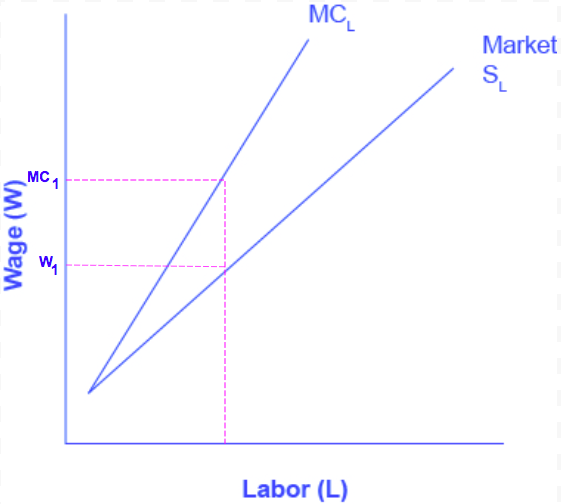
Effigy 1. The Marginal Price of Labor. Since monopsonies are the sole demander for labor, they face the market place supply curve for labor. In gild to increment employment they must enhance the wage they pay not simply for new workers, but for all the existing workers they could have hired at the previous lower wage. As a result, the marginal price of additional hiring labor is greater than the wage, and thus for any level of employment (above the first worker), MCL is above the Market place Supply of Labor.
If the house wants to maximize profits, information technology will rent labor up to the point Lone thousand where DL = VMP (or MRP) = MCL, as Figure ii beneath shows. So, the supply curve for labor shows the wage the firm volition have to pay to attract Lm workers. Graphically, we can draw a vertical line upwardly from Lm to the Supply Curve for characterization and then read the wage Wm off the vertical axis to the left.

Figure 2. Labor Market place Outcomes Under Monopsony. A monopsony will rent workers up to the bespeak L1000 where its demand for labor equals the marginal cost of additional labor, paying the wage Wthousand given by the supply curve of labor necessary to obtain Fiftym workers.
How does this outcome compare to what would occur in a perfectly competitive market place? A competitive market would operate where DFifty = SL, hiring Lc workers and paying Wc wage. In other words, nether monopsony employers rent fewer workers and pay a lower wage. While pure monopsony may be rare, many employers accept some caste of market power in labor markets. The outcomes for those employers will be qualitatively like though not as extreme equally monopsony.

Effigy 3. Comparing of labor market outcomes: Monopsony vs. Perfect Competition. A monopsony hires fewer workers Lchiliad than would be hired in a competitive labor market 50c. In exploiting its market ability, the monopsony tin too pay a lower wage Wm than workers would earn in a competitive labor market Due westc.
Try It
Glossary
- marginal toll of labor:
- the cost to the firm of hiring one more than worker
- monopsony:
- a labor market where there is only one employer
Contribute!
Did you take an idea for improving this content? We'd love your input.
Improve this pageLearn More
Source: https://courses.lumenlearning.com/wm-microeconomics/chapter/labor-market-power-by-employers/

Post a Comment for "What Can a Firm With Market Power Do"