How to Permit 100 of All Upload Bandwidth in Meraki Dashboard
Getting Started
Welcome to Cisco Meraki! This guide will walk you through how to get started in the Meraki dashboard, the centralized cloud management platform for all Meraki devices and services. It is intended for network administrators who volition be monitoring and managing Meraki products.
Getting Started Checklist
As opposed to traditional hardware that requires concrete admission to be configured, you lot tin configure everything before you lot fifty-fifty have your devices, cheers to the Meraki cloud. Meraki devices get their configuration settings from the Meraki cloud, which ways the only prerequisite to getting a device upward and running is an uplink connectedness on the device itself. Equally long as your device tin get to the internet and has the appropriate firewall rules configured, as outlined in our article, Upstream Firewall Rules for Cloud Connectivity, your device will be able to contact the Meraki cloud and written report on its functioning, as well as check for and download its latest configuration.
All of your configuration settings can exist gear up upwardly in the dashboard, either before you have the device or after. There is a tremendous amount of flexibility with the initial setup for a Meraki deployment. Here's a list of the things yous'll need to set up for your kickoff devices and networks while following this document:
- A Meraki dashboard account and organization: you'll create an organization at the same time y'all create your account
- An social club number for a Meraki buy or the serial numbers of your devices
- An thought of what y'all want to do with your devices and how to group them
- An uplink to the cyberspace for your devices with valid firewall rules configured and so they can talk to the Meraki cloud
That's all you need to get started with Meraki! Before moving into creating a dashboard account, let'south address some terminology that will come up throughout documentation and the dashboard itself.
Introduction to the Meraki Cloud and Dashboard
The Meraki cloud is the backbone of the highly available, secure, and efficient Meraki solution, enabling instant onboarding admission to all features inside the Meraki dashboard. Information technology is comprised of highly reliable servers at diverse data centers around the world. The Meraki dashboard itself is a centralized, spider web browser-based tool used to monitor and configure Meraki devices and services. A dashboard account is what you use to log in to the dashboard in order to manage and configure your organizations, networks, and devices.
It is of import to note that "organization" and "network" in this sense are from the perspective of the dashboard. In the Meraki dashboard, an "organization" is a logical container for Meraki networks managed past one or more accounts. A dashboard "network," on the other hand, is a logical container for a set of centrally managed Meraki devices and services. Devices go in a network, networks get in an organization, and organizations are managed by user accounts from the Meraki dashboard. All of this information, as well as device configuration settings, is stored in the Meraki cloud.
Nosotros highly recommend theMeraki Cloud Architecture article for boosted information regarding the Meraki cloud and how devices communicate with it.
Creating a Dashboard Business relationship
In gild to brainstorm, yous'll first need to create an account in the Meraki dashboard, if you don't have one already. For more than information about how the dashboard is organized, please refer to our documentation on the Meraki Dashboard Organizational Structure.
- Navigate to https://dashboard.meraki.com.
- SelectCreate an account.
- Select the region your Meraki dashboard business relationship and organization will reside in. All information related to your dashboard system will reside on servers in the selected region. Ensure that this is accurate, as it cannot be changed afterward.
- Provide the requested information.
- Email - The e-mail address that will exist used to log in to the dashboard, and for administrator communication.
- Full Proper name - The name that will be displayed for your account in logs, selection fields, and when contacting Meraki Support.
- Password- Passwords must be at to the lowest degree eight characters long. Nosotros recommend using a mix of lower- and capital letter letters, numbers, and special characters.
- Visitor- The name of your visitor or organization; e.g., Cisco Systems, Inc.
- Accost- (optional) An address that can be used every bit the default for network locations and maps within the dashboard.
- SelectCreate account at the bottom of the page.
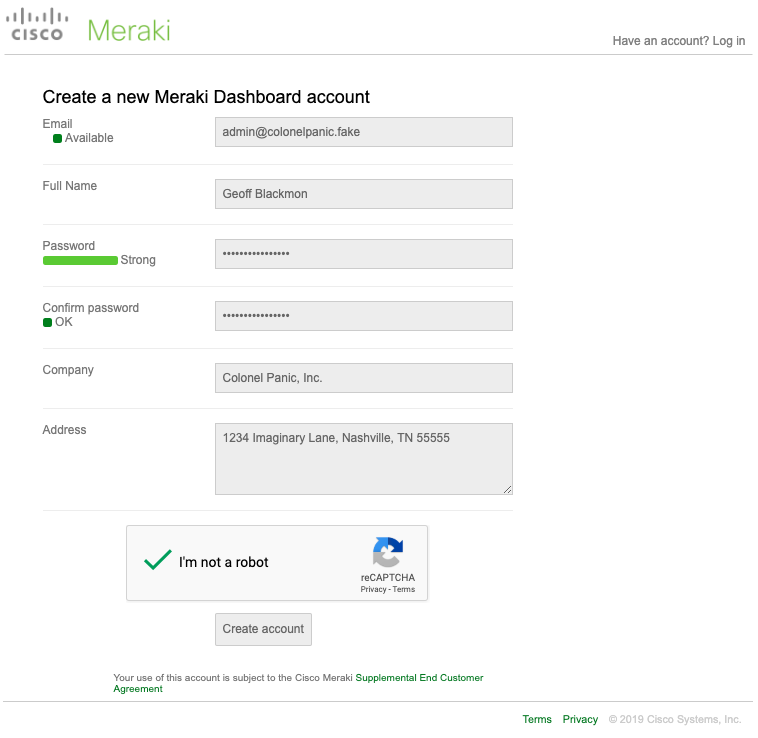
Congratulations! You've successfully created a Meraki dashboard account and organisation. In the above example, we created the arrangement "Colonel Panic, Inc." under the dashboard business relationship "admin@colonelpanic.faux" - note that in reality, a valid electronic mail address is required when making the business relationship. Before continuing, check your email and interact with the confirmation link to verify your account. You will be unable to admission the newly created dashboard organization or log in to your account until the email address is verified.
Creating a Network
Now that you lot have a Meraki dashboard business relationship and organisation, information technology'due south time to create a network. Networks are used to contain devices and their configurations. It's common exercise to create a device network for each physical location. For example:
- NYC - wireless and security appliances
- SF - switches, cameras, wireless and security appliances
To create a hardware or device network:
- Log in to https://dashboard.meraki.com using the account created earlier.
- From the prompt window, chooseAnnals Meraki devices and select Next.
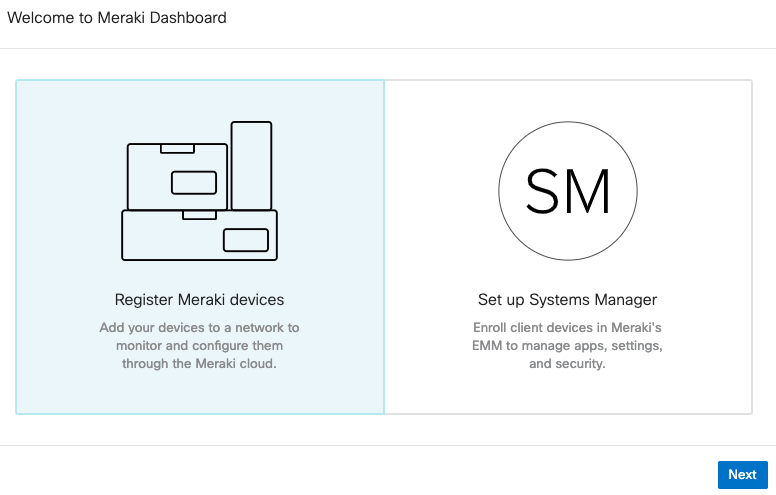
Note: If you do not see this prompt in your Meraki dashboard, navigate to System > Configure > Create network in the left-side pane instead.
- Provide the requested information to create the network and annals the devices on-manus.
- Name - The proper name that will be used to identify this network in the Meraki dashboard, e.thousand., "NYC - Wireless" or "SF Part"
- Network type - Choose which type of Meraki device(south) will be managed in this network.Notation:This drop-down is not shown unless you are creating the network through theOrganization > Configure > Create network page. If you used the prompt shown to a higher place, the created network will automatically exist the correct blazon for the device(s) added. If two or more device types are added, the network will be created as aCombined network.
- Wireless - Wireless access points (MR serial)
- Security appliance - Security apparatus (MX serial) or teleworker gateway (Z Series); please note only i of these devices tin exist per network
- Gateway- Cellular Gateway (MG series)
- Switch - Access and aggregation switches (MS series)
- Photographic camera - Security cameras (MV series)
- Combined hardware - These networks tin contain a mix of any (or all) of the above devices; delight notation that the limit of 1 MX or Z-series device yet applies
- Devices(optional) - If you take an order number or device serial number on manus, it can be added here, otherwise, refer to the Adding Devices and Licenses department once this information is bachelor. Adding a device at this stage will allow you lot to add it directly to the network.
- Enter an order number (due east.g. 5S######) or device serial number(s) (e.g. Qxxx-xxxx-xxxx) in the box next to the blue Claim push button, one per line.
- SelectClaim.
- Tick the checkbox side by side to whatsoever desired devices and they will exist added to the network once created.
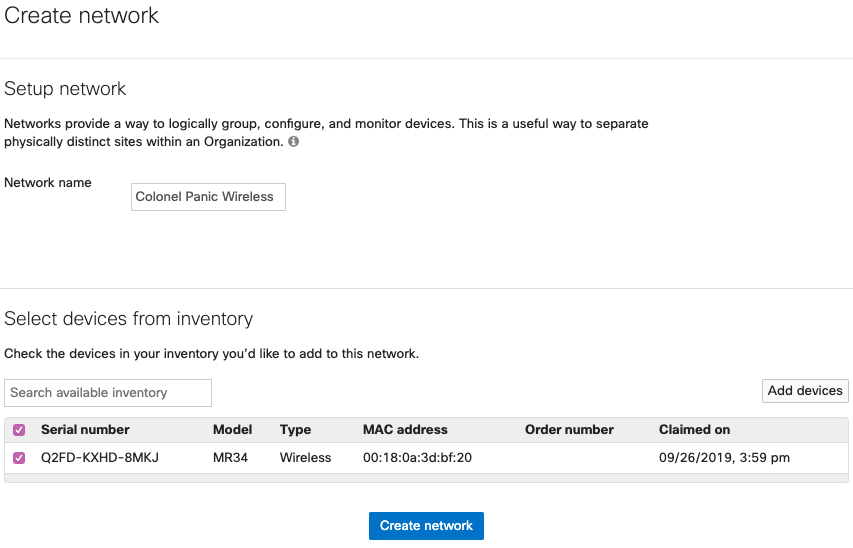
- ChooseCreate network.
With that, you've successfully created a Meraki dashboard device or hardware network. This is where y'all'll be able to configure and manage your Cisco Meraki devices; look in the left-side console to access your newly created network. If you would like to learn more near the benefits of combined networks and how to combine networks after creation, please refer to our Combined Dashboard Networks commodity.
Creating a Systems Managing director Network
To create a Systems Manager network for endpoint direction, a slightly different process is followed.
- Log in to https://dashboard.meraki.com using the account created earlier.
- From the prompt window, choosePrepare Systems Managing director and selectNext.
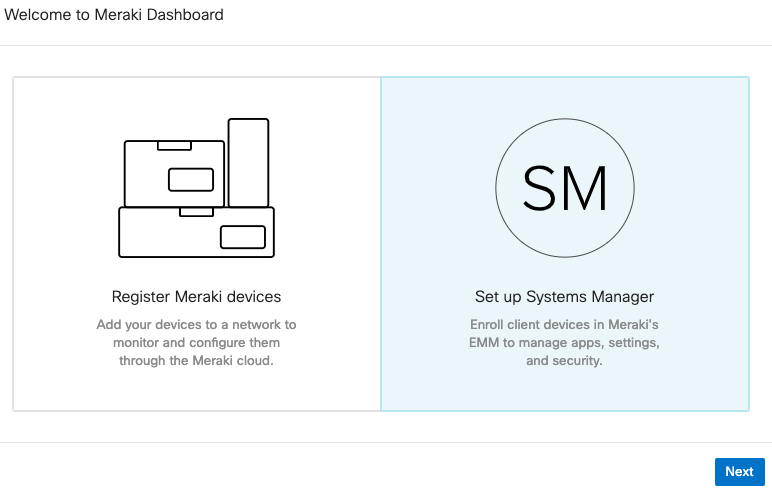
Note: If you practice not run into this prompt in your Meraki dashboard, navigate to Organization > Configure > Create network in the left-side pane instead.
- Give the network a name, for example, "Visitor Phones." If the folio has a drop-down forNetwork blazon, selectEMM (Systems Director).
- Review the page, then selectCreate network at the lesser of the screen.
Once complete, you lot've successfully created a Meraki Systems Managing director network. This is where you tin configure profiles, payloads, applications, and many other features for endpoint management. This network type tin exist combined with hardware networks if desired, but is generally kept dissever for ease of administration. Endpoint management is rarely tied to a single location, and so having a standalone network for all managed endpoints is a mutual practice. For an overview of common questions and additional links to getting started, please consult our Systems Manager FAQ article.
Adding Devices and Licenses
While a network tin exist configured without whatever devices in it, devices demand to exist added to a network to download their configuration. You'll also need to add the licenses for those devices. This tin easily be done in ane stride using the order number associated with your devices and licenses.
- Inside the Meraki dashboard, navigate toOrganization > Configure > Inventory using the left-side navigation bar.
- In the box next to the blue Claim push button, enter order numbers, one per line.
- If this box does non appear, devices were added already. SelectClaim in the upper right corner of the page to bring upwardly the dialog.
- If an lodge number is non bachelor, series numbers for devices can exist entered instead, one per line. We suggest inbound guild numbers when possible, as this will also claim whatsoever corresponding licenses that were role of the order, as opposed to needing to add them manually.
- CullClaim.
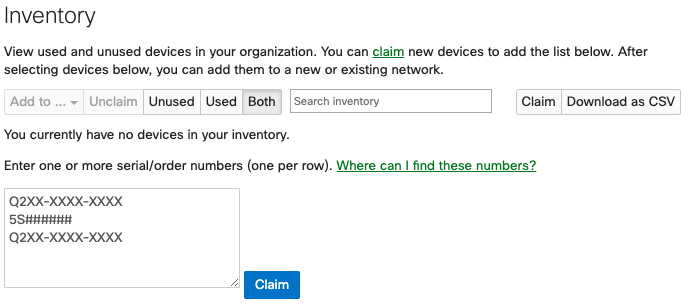
At this point, a list of devices should appear in the inventory. These devices tin and so exist added to networks, similar the one created earlier.
- Tick the checkbox side by side to any devices that should be added to the network.
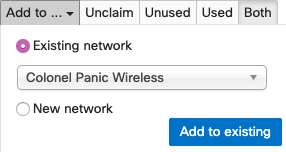
- SelectAdd together to above the inventory list.
- NetherExisting network, choose the network that was created earlier.
- SelectAdd to existing.
Note: Recollect that only a single MX or Z-serial device tin can be contained in a given network, unless a secondary MX is to exist used as a warm spare. To configure two MX appliances for warm spare functionality, follow these instructions to add the start MX appliance, then refer to our documentation on the MX Warm Spare characteristic for more than info.
Once this footstep is complete, the device(s) selected volition now be located in the network and are ready to be configured.
Manually Adding Licenses
If the guild number associated with a license is not known, or the license was ordered separately from the devices, it may be necessary to add a license manually. This license key should have been received via e-mail from aircraft@meraki.com or your authorized Meraki distributor.
- Within the Meraki dashboard, navigate toSystem > Configure > License info.
- Select the link toAdd another license.
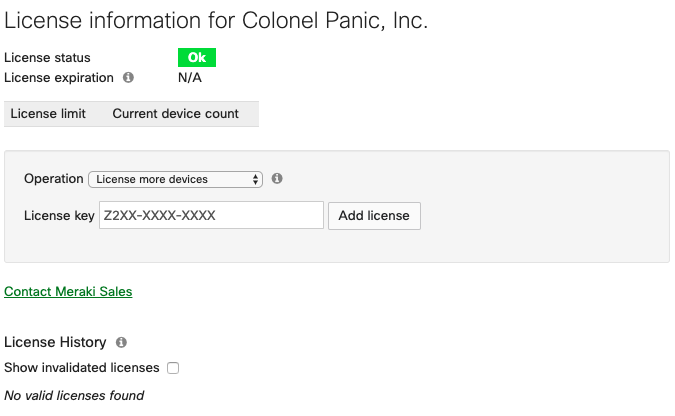
- For theOperation, choose "License more than devices."
- Enter theLicense key in the box provided. Enter the key exactly as provided, including dashes. License keys are provided in the format Zxxx-xxxx-xxxx.
- ChooseAdd license.
- On the following folio, ostend the accuracy of the details shown; if everything looks correct, selectAdd license.
The license primal will now be added to the organization. If boosted licenses need to exist added, repeat the steps above. For more information about license management and guidelines, please consult our commodity. Cisco Meraki Licensing Guidelines and Limitations.
Next Steps
If yous've been following along with this document - congratulations! You've successfully created your dashboard account and dashboard organization, the first dashboard network contained in that organization, and have added your first device(s) to that network. Y'all've likewise added the advisable licensing to your organization. At this point, you're fix to offset configuring and setting up your devices. This section will help direct you toward the right documentation to keep moving forward - and if yous have questions that aren't answered in the beneath manufactures, check out our documentation library.
Using the Local Condition Folio
Meraki MX/MR/MS series devices have a local status page that tin be accessed to perform limited local configuration changes, monitor device status and utilization, and perform uncomplicated local troubleshooting. This page is useful when initially deploying new devices, as information technology allows for IP assignment on the device as well as basic status information during first-fourth dimension setup. A breakup of the options on the local status page for each of these devices, as well as how to admission them, can be found in our Using the Cisco Meraki Device Local Status Folio article.
Calculation and Managing Administrators
Now that you have an system with a network and devices, we recommend that you add at least one other administrator. This provides redundancy in the upshot 1 ambassador is locked out due to failed password attempts or is otherwise unable to access the Meraki dashboard. Details on adding additional administrators and the various permissions and roles they can have are covered in our Managing Dashboard Administrators and Permissions article.
Recommended Reading and Additional Resource
The following listing of manufactures will assistance to further your cognition regarding the Meraki dashboard and how things piece of work. Nosotros recommend these articles so you lot tin leverage the full functionality and features of the Meraki dashboard and your devices.
- Best Practices for Meraki Firmware - Meraki has ever prided itself on delivering powerful networking and IT solutions in a elementary, easy-to-manage fashion. This extends to firmware direction on Meraki devices.
- Licensing FAQ - This article answers mutual questions regarding Meraki licensing and supplements the guidelines and limitations article linked before in this document.
- Cisco Meraki Dashboard API - The Meraki dashboard API is an interface for software to interact directly with the Meraki cloud platform and Meraki-managed devices. The API contains a prepare of tools known as endpoints for building software and applications that communicate with the Meraki dashboard for use cases such equally provisioning, bulk configuration changes, monitoring, and role-based access controls.
- Managing Multiple Networks with Configuration Templates - Configuration templates allow many Meraki devices to exist deployed using a unmarried base of operations configuration. This makes it much easier to roll out new sites/users and maintain consistency across each site's configuration. Information technology is most useful in cases where a large number of sites exist that share a common network design.
Source: https://documentation.meraki.com/Getting_Started

Post a Comment for "How to Permit 100 of All Upload Bandwidth in Meraki Dashboard"